


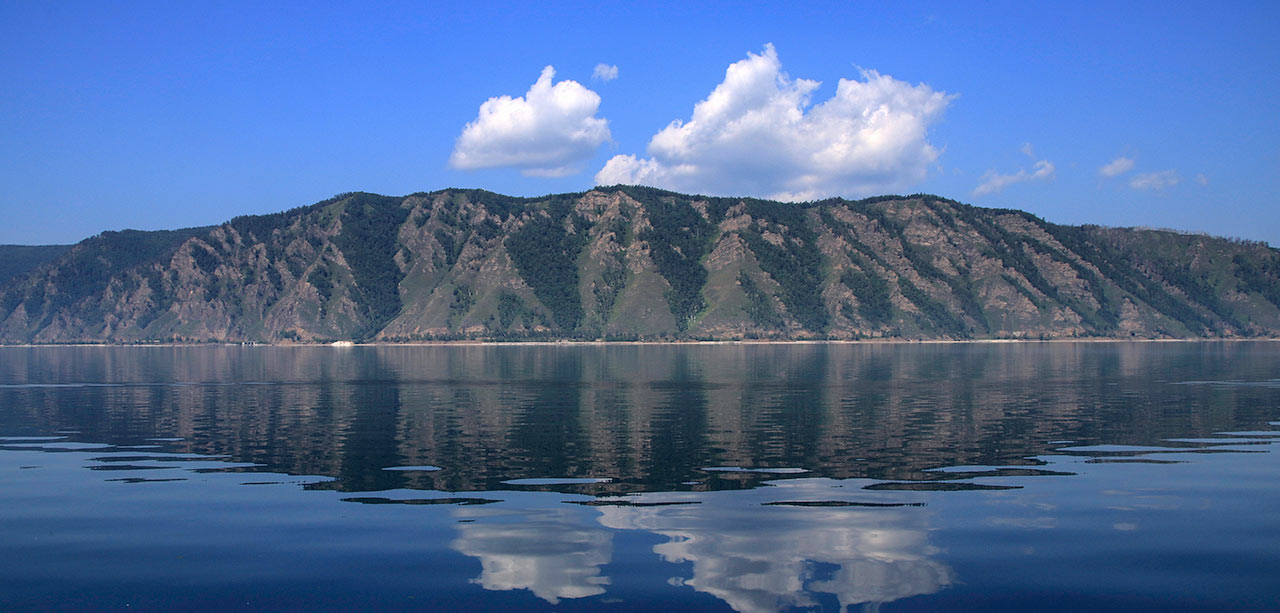
VII All-Russian scientific conference with international participation
PLANT AND MICROORGANISM RESISTANCE TO UNFAVORABLE ENVIRONMENTAL FACTORS
July 5-10, 2026 (Irkutsk – Listvyanka)
Listvyanka and Excursions
Listvyanka is among the most ancient settlements upon the shores of Lake Baikal, situated at the source of the River Angara, some seventy kilometres from the city of Irkutsk. In the year 2026, the settlement shall officially commemorate the three-hundredth anniversary of its foundation. It arose in the early years of the eighteenth century as a winter station and postal stop upon the great route leading to Transbaikalia and China. The name of the settlement derives from Cape Listvennichny, once thickly covered with larch trees. For a considerable period, Listvyanka served as the principal port of Lake Baikal: ships were constructed here, customs services operated, and fishing flourished. In the nineteenth century, all scientific expeditions devoted to the study of Siberia passed through this place. Today, Listvyanka stands as the chief tourist hub of Lake Baikal and is undergoing extensive modernisation in preparation for its jubilee.
On the day of arrival, we propose an introductory excursion entitled “Evening Listvyanka”.
During this excursion, visitors shall behold the Shaman Stone – a rocky outcrop dividing the waters of Lake Baikal and the Angara River, associated with the graceful legend of Baikal and his daughter Angara. We shall also visit the Church of St. Nicholas, a monument of Russian folk architecture in Listvyanka. Thereafter, we shall proceed to the fish market, where local fish and souvenirs may be purchased, or one may simply stroll along the lakeshore.
The acquaintance with the settlement may fittingly conclude with a visit to the Baikal Astrophysical Observatory. Here, scholars engage in the study of solar activity and the development of advanced scientific instruments. Within the framework of this excursion, guests ascend to the observation platform of the largest solar vacuum telescope in Eurasia and observe the setting sun above Lake Baikal— a spectacle of uncommon beauty.
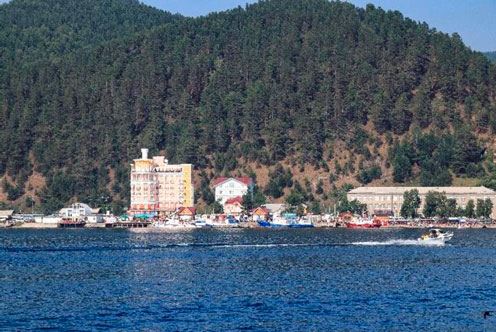
Listvyanka. Photo made by Nicolai Dorofeev
Baikal Museum of the Siberian Branch of the Russian Academy of Sciences
On one of the days allotted to the conference, a visit is made to the Baikal Museum of the Siberian Branch of the Russian Academy of Sciences. This institution is properly to be considered a limnological museum, wherein the visitor may acquire a comprehensive understanding of the unique flora, fauna, and the long history of scientific inquiry relating to Lake Baikal. The museum contains living exhibitions, including aquariums with native species, among which the Baikal seal deserves particular notice. There are likewise collections of minerals, bottom sediments, plants, and various artefacts obtained in the course of scientific expeditions.
The museum is situated at the source of the Angara River and forms part of a larger scientific complex. In addition to its traditional displays, it offers educational and interactive exhibitions, including a virtual descent to the bottom of the lake, by which modern methods are employed to extend knowledge beyond the limits of ordinary observation.
Water Tour on Lake Baikal along the Circum-Baikal Railway
A water excursion along the Baikal Railway affords some of the most striking views of Lake Baikal, together with an uninterrupted succession of cliffs and capes of singular beauty. Amidst this scenery stands a preserved section of the Trans-Siberian Railway, constructed between the years 1896 and 1905. This work may justly be regarded as the summit of the architectural and engineering skill of its time and was, at its completion, both the most costly and the most difficult portion of the Siberian railway system.
or these reasons, it acquired the appellation of the “Golden Buckle of Russia’s Steel Belt.” Within a distance of no more than eighty-nine kilometres are contained thirty-eight tunnels, fifteen stone galleries, three galleries of reinforced concrete, two hundred and forty-eight bridges and viaducts, and two hundred and sixty-eight retaining walls, the labour of engineers and workmen drawn from Russia and several countries of Europe.
The vessel employed upon this excursion makes several stops, allowing passengers to land at those points which present the greatest historical or natural interest.
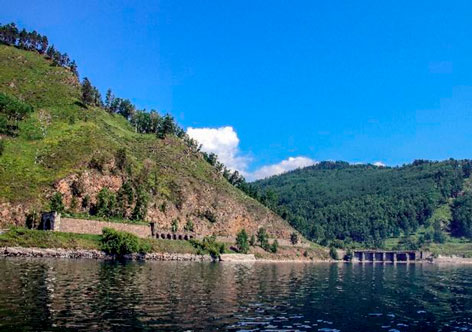
Baikal Railway. Photo made by N. Dorofeev.
Excursion to the Settlement of Bolshiye Koty
Bolshiye Koty is a small and remote settlement situated upon the western shore of Lake Baikal, at a distance of eighteen kilometres to the north of Listvyanka. Its origin and early prosperity are connected with the extraction of gold, which commenced in the middle of the nineteenth century.
Access to the settlement may be obtained either by water or by proceeding on foot along the Great Baikal Trail. Owing to this limited accessibility, the flow of visitors remains moderate, permitting a more tranquil enjoyment of the surrounding scenery. From the settlement, one may ascend the modest elevation known as Grebeshok for an improved prospect, while those of greater physical preparation may continue to the Skriper Cliff (one-way distance about 4.5 km). Bolshiye Koty also contains one of the oldest research stations of Irkutsk State University, wherein the Museum of Baikal Studies is situated.
Visitors may further proceed to the valley known as Black Valley, located at a distance of three kilometres, which formerly witnessed active gold mining. Two methods of return are proposed: either by high‑speed vessel, requiring approximately thirty minutes, or by continuing on foot along the Great Baikal Trail to the Yemelyanikha Valley (distance about 10 km), from whence a vessel returns to Listvyanka. This latter route, though highly esteemed for its natural beauty, contains certain exposed sections and requires suitable footwear and caution. The duration of the walk is approximately four hours.
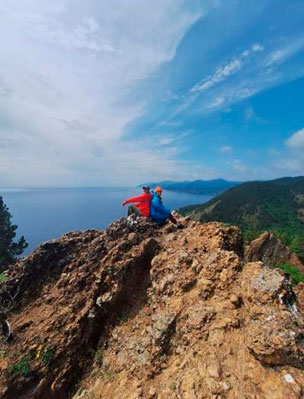
Bolshiye Koty and Skriper Cliff. Right photo by Marina Polyakova.
Architectural and Ethnographic Museum of Taltsy
On the day of departure, a visit is proposed to the open‑air museum of Taltsy, situated at the fortyseventh kilometres of the Baikal Highway. This institution ranks among the largest ethnographic museums of its kind in the country. Occupying an area of seventy hectares, it comprises more than one hundred and sixty architectural monuments, maintains forty permanent exhibitions, and preserves collections exceeding thirty‑five thousand artefacts.
The museum is established upon the banks of the Angara River, where historical structures are combined with contemporary facilities, thereby forming a space suited both to study and to public recreation.
Time and Expense of the Principal Excursions
The dates and approximate costs of the excursions are as follows:
| On the 5th of July, 2026: an evening sightseeing tour of Listvyanka with a visit to the Baikal Astrophysical Observatory, of three and a half hours’ duration, at an estimated cost of 1000 rubles. |
| On the 7th of July, 2026: a visit of two hours to the Baikal Museum of the Siberian Branch of the Russian Academy of Sciences, the principal exhibition being free of charge. |
| On the 8th of July, 2026: excursions of eight hours’ duration, among which three routes are offered: a boat excursion along the Baikal Railway – 8000 rubles; an excursion to Bolshiye Koty with return partly on foot (distance about 10 km) – 3500 rubles; or an excursion to Bolshiye Koty with return entirely by vessel – 4000 rubles. |
| On the 10th of July, 2026: a four-hour visit to the Taltsy Museum, at an estimated cost of 500 rubles. |
Certain Practical Recommendations for Visitors
As to the climate, it may be observed that while the days may be exceedingly warm, strong winds are frequent, and the coldness of the lake renders the air chill even in summer. A hat, protection from the sun, and a wind‑resistant jacket are therefore advisable. Nights are often cold, for which reason warm clothing is recommended.
Proper footwear is of great importance, the shores being strewn with small and sharp stones. Swimming in the lake is possible, though the rocky bottom renders protective footwear useful. Insects may be troublesome in the evening and in wooded areas, and suitable repellents should be carried. During boat excursions, warm garments are indispensable, as the motion of the vessel greatly increases exposure to cold air.
Visitors are advised to carry necessary medicines, bearing in mind that the particular natural conditions of the region may occasion temporary discomfort. Finally, in forested areas, precautions against ticks are essential, and insurance against tick-borne illness is strongly recommended.